
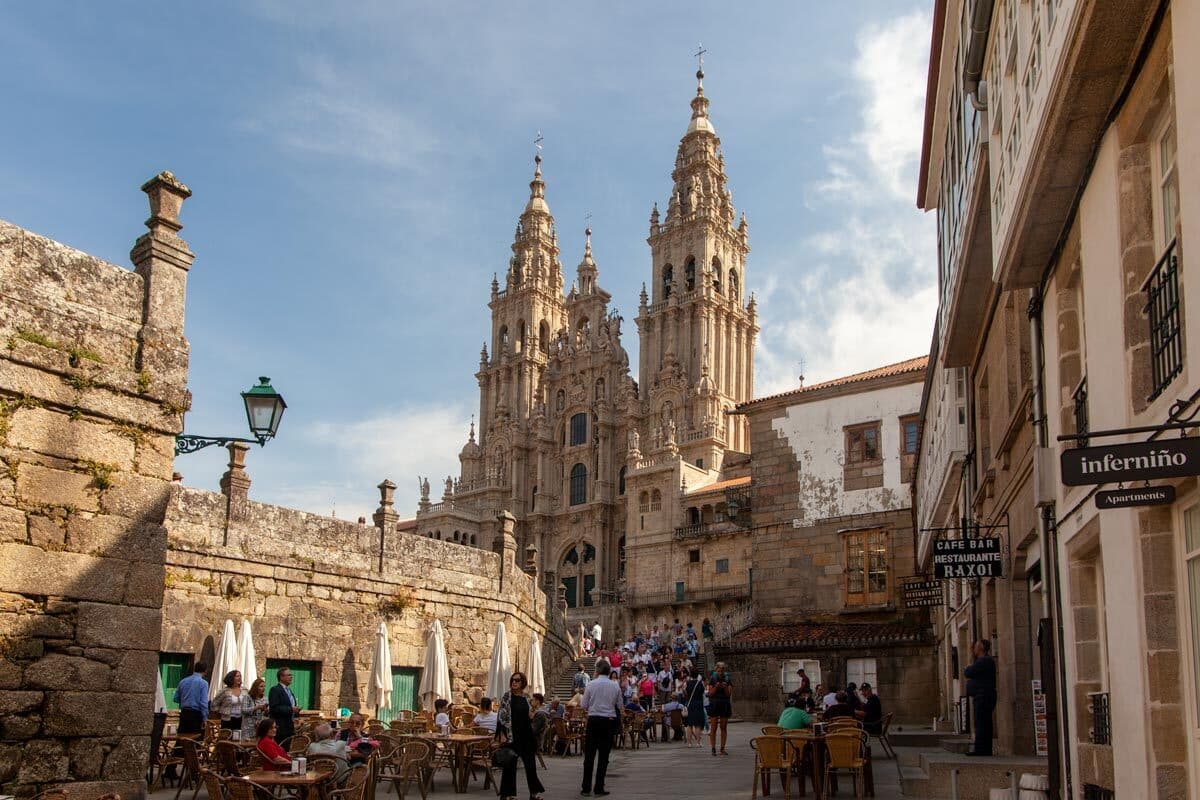
Since its inception, the Camino de Santiago has been a unifying drive. I’d even dare to say that within the Center Ages, all roads led to Santiago de Compostela.
Whereas the pilgrimage to Galicia’s present capital started as an act of Christian religion, over the centuries it has developed right into a community of non secular long-distance walking routes that enable travellers to commune with nature and immerse themselves within the cultures of the cities and cities they cross via.
Galicia is one in all my favorite areas in Spain, and I all the time say: Galicia is way more than simply the Approach of St James. However, I imagine the most effective methods to actually perceive Galicia’s historical past, admire its biodiversity, and study Galician tradition is to stroll the Camino routes that traverse the area and result in Santiago de Compostela.
On this article, I’ll present some recommendation on how one can put together and plan a extra non secular Camino de Santiago, beginning within the region of Galicia – in case it’s your first time or you might be quick on time.
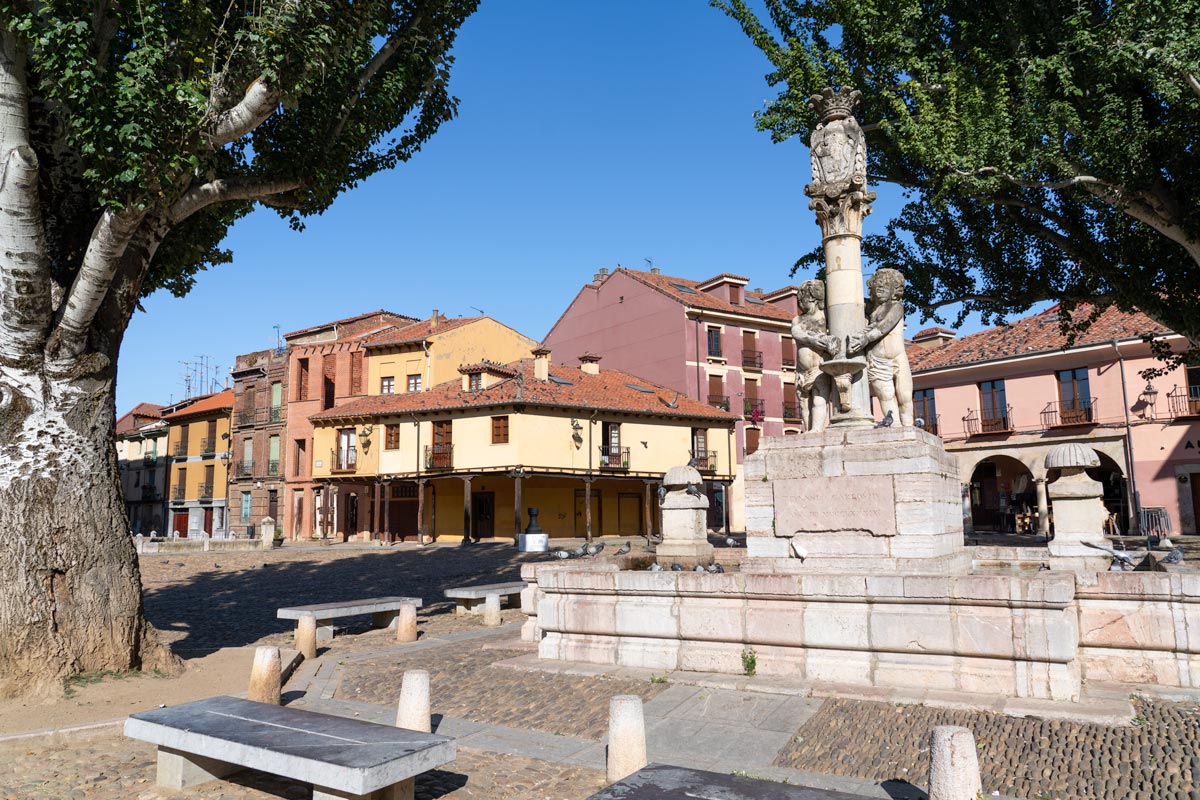
Why the Camino de Santiago is a extra non secular than spiritual pilgrimage route
The assumption that the stays of St James the Better, who was beheaded in Jerusalem, appeared in a forest in Galicia on the finish of the ninth century, was the origin of town of Santiago de Compostela and the Christian pilgrimage in the direction of it, often called the Camino de Santiago (St James’ Approach).
Within the Center Ages, as town and the clergy grew richer and the modest church that housed the supposed physique of St James was remodeled into an ostentatious cathedral, the pilgrimage additionally underwent a big transformation.
Communion with nature, reference to locals and pilgrims from different nations, and the cultural experiences within the cities and cities that pilgrims traversed steadily turned the tomb in Santiago de Compostela into an invite to embark on a journey of inside transformation via the forests, valleys, and mountains of Spain and Europe.
Though the Camino de Santiago emerged as a Christian pilgrimage, it has since developed into a preferred collection of spiritual pilgrimage routes. A pilgrimage that now attracts hundreds of thousands of travellers from everywhere in the world, no matter their beliefs.

Find out how to put together and plan in your Camino to Santiago de Compostela
To organize and plan your Camino to Santiago de Compostela, you have to be absolutely conscious of your bodily talents. You must also be clear about your priorities, the season by which you wish to do it, and the time you may have accessible. This can enable you select essentially the most appropriate route.
Bodily preparation for the Camino de Santiago is important, particularly in case you are not used to mountaineering or don’t practise sports activities. Are you able to stroll at the least 5, 10 and even 20 kilometres a day for per week? Have you ever slept in shared hostel rooms, and are you keen to be prepared by 8 a.m. to stroll the following stretch? Do you may have appropriate footwear for lengthy walks, and are you used to travelling gentle?
In case your reply to those questions is not any, you may wish to begin coaching or think about other ways to make your non secular journey to Santiago de Compostela. There’s a vary of boutique lodges and visitor homes alongside many routes, providing higher consolation for individuals who favor a much less easy pilgrimage.
Keep in mind that summer season is the excessive season, so if you wish to keep away from crowds, it’s advisable to do the Camino in spring or autumn. Significantly should you plan to remain in public hostels (pilgrim hostels) in Galicia, as reservations aren’t attainable. Beds are allotted on a first-come, first-served foundation.
As for selecting a route, if you wish to mix sea and mountains, go for the Northern Approach, the English Approach or the Portuguese Coastal Approach. In case you are fascinated by historical past, tradition and structure, select the Primitive Approach or the French Approach.
And should you can solely do the Camino in winter, go for the Winter Approach, a secondary route that begins in Ponferrada, Spain (pending official designation), though you need to anticipate to come across setbacks and stay alert to warnings of rain and robust winds.
That are the preferred Camino de Santiago routes?
Primitive Path
Size: 168.1 km by way of A Proba de Burón – 166.9 km by way of San Xoán de Padrón
Issue: Low
Upon receiving information of the alleged discovery of the tomb of St James the Great within the Libredón forest, King Alfonso II of Asturias travelled from Oviedo to what’s now town of Santiago de Compostela. After “confirming” that these had been certainly the stays of the apostle, the king turned the primary pilgrim, and his itinerary established the primary pilgrimage path to Santiago de Compostela.
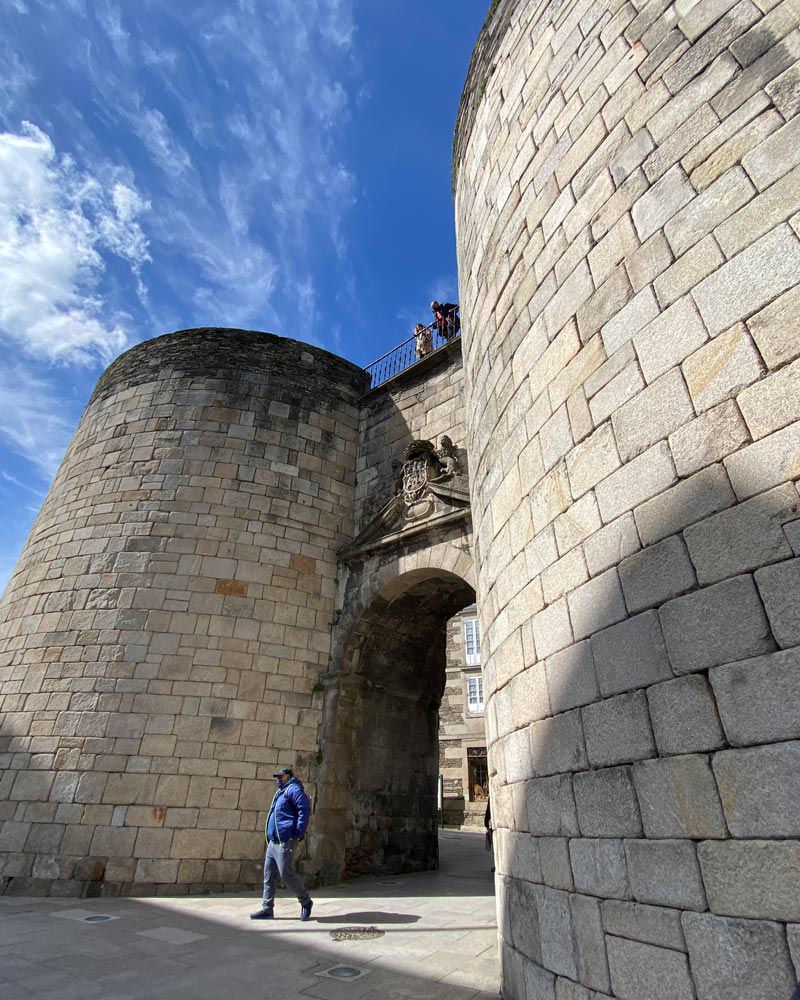
This route winds via charming landscapes, lovely villages and pre-Romanesque, Romanesque and Gothic church buildings, equivalent to these of Soutomerille, San Romao da Retorta and Santa María de Vilabade, respectively. Apart from, you’ll be able to stroll alongside the majestic Roman Partitions of Lugo, preserved virtually intact since their development between the third and 4th centuries CE, and go to its cathedral, that includes a mixture of architectural kinds starting from Romanesque to Neoclassical.
North Highway
Size: 190.3 km by way of Ribadeo – 184.3 km by way of Santiago de Abres
Issue: Medium
From skirting the Cantabrian Sea to discovering the inside of Galicia, beginning on the mouth of the River Eo in Ribadeo. This route in Northern Spainprimarily frequented by pilgrims from northern Europe, has additionally been travelled by a number of illustrious figures, together with St Francis of Assisi.
Alongside this route, you’ll cross via lovely hamlets and bucolic surroundings, traverse the UNESCO Terras do Miño Biosphere Reserve, and go to emblematic monuments such because the Gothic-style Cathedral of Mondoñedo, the Fifteenth-century octagonal Torre dos Andrade transformed into Parador de Vilalba, and the Tenth-century grandiose Monastery of Santa María de Sobrado dos Monxes.
French Approach
Size: 162.2 km by way of Samos – 155 km by way of San Xil
Issue: Medium
This is likely one of the most iconic and worldwide routes, recognised alongside the Primitive Approach and the Northern Approach as a UNESCO World Heritage Site in 2015 for its intensive historic and inventive heritage and for serving as a cultural hall between the Iberian Peninsula and the remainder of Europe.
After crossing the Pyrenees, the 4 French routes described within the Twelfth-century Codex Calixtinus by the cleric Aymeric Picaud converge at Puente de la Reina (Navarre) and proceed as one via northern Castile and León till they enter Galicia by way of the pre-Roman village of O Cebreiro.
On this route, you’ll cross via lush chestnut and oak forests, enchanting villages equivalent to Sarria, Portomarín, Palas de Rei and Melide, and admire a number of Romanesque and Gothic church buildings. When you don’t have a lot time, think about strolling the Camino de Santiago from Sarria, as the ultimate, scenic stretch could be accomplished in per week.
Portuguese Approach
Size: 118.8 km inland – 163.1 km alongside the coast
Issue: Medium-Low
After Portugal gained independence from the Spanish monarchy within the Twelfth century, spiritual pilgrimages continued, and a route was established from Lisbon, branching off at Oporto to proceed alongside the coast to A Guarda and inland to Tui. Each routes converge once more in Redondela.
Highlights alongside the coastal route embrace the placing Castro de Santa Tegra, Baiona’s Parador Nacional in Monterreal Citadel, and Vigo’s Outdated City.
The place to remain alongside the Camino de Santiago?
Galicia is well-known for its hospitality. All through the eleventh and thirteenth centuries, through the peak of pilgrimages to Santiago de Compostela, a number of hospitals had been established alongside the routes to supply shelter and take care of pilgrims.
These days, pilgrim hostels (pilgrim hostelsin Spanish and Galician) fulfil this perform. In Galicia, there’s a public community of hostels on the Methods of St James (Crimson Pública de Albergues de los Caminos de Santiago en Galicia) that permits pilgrims with a credential to remain in a single day for €10.
Though you need to keep in mind just a few issues: no reservations could be made (apart from folks with disabilities), locations are allotted on a first-come, first-served foundation from 13h, you’ll be able to solely keep one night time in every hostel, and check-out is till 8h.
When you favor to do the Camino with out guidelines and in luxurious, that can be attainable. Native tour corporations, equivalent to Viajes Camino de Santiago, can tailor mountaineering routes that keep in luxurious lodges and embrace VIP companies, equivalent to baggage transfers.
What cultural experiences can travellers anticipate alongside the Camino?
The routes of the Camino de Santiago cross the mountains, forests, plains and estuaries of the area of Galicia, permitting pilgrims to find its wealthy cultural heritage throughout their non secular journey.
The Roman legacy (the partitions of Lugo and the Tower of Hercules) and Santiago de Compostela’s Outdated City are UNESCO World Heritage Websites, and plenty of of its cities and cities have been declared historic-artistic websites resulting from their uniqueness, equivalent to Baiona, Mondoñedo, Ferrol’s Barrio da Magdalena, and A Coruña’s Outdated City.
Of all Spain’s varied itinerariesthe Camino de Santiago arguably offers essentially the most numerous cultural expertise and a number of the nation’s most celebrated delicacies.
Source link